Tao
What is Taoism?

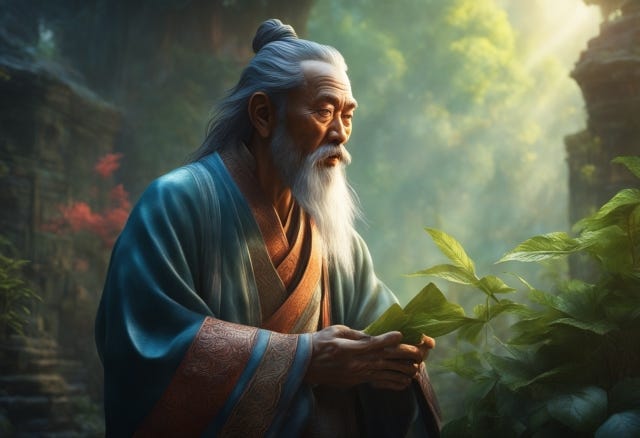
Tao (Pronounced, 'Dow')
Taoism in its truest form, is not a religion. It is a philosophy, a philosophy of life. It is a way of living, of viewing life. So in this respect, it is not only a philosophy but The Way as it is called. So the Way is a spiritual-philosphical tradition from ancient China. It is Taoist at its core.
Tao is a basic, fundamental, essential force or guiding principle that permeates the Cosmos or existence. (No, it is not 'The Force' of Star Wars.) Taoism has to do with harmony and the correct course of action. This is The Way. The wise man, or the Superior Man* as it is sometimes called in this philosophy will always bow to The Way. (*wise man or woman).
Taoism cannot be explained directly, it is best perceived intuitively. So, it cannot be comprehended as a dogma. It is felt rather than being seen or described. So in order to understand Taoism, you must approach it from the fringes.
In Life we react to things from the way we perceive. How we perceive it will vary from person to person. For some, they may react with activity, for others they may react with tranquility. If there are events in life that are not to our liking, our first inclination may be to react with rebellion or opposition. This may not always be the best course of action. With Taoism, we are concerned with the best course of action. This will be the wisest course of action.
How can we know the wisest course of action for any event or circumstance in life? We seek the Taoist way. With the Taoist way, often we might do nothing. We may go with the flow of things. Other times we may take a passive-active way.
Contrary to what is thought of Taoism, it is not passive. What is perceived outwardly by a Taoist as passive is inwardly active. This means that non-action is an active reaction inwardly. In Taoist philosophy nothing changes but change itself. How change is perceived is important. If you experience what you think as an event or a condition or situation in life as detrimental, it may not be actually so.
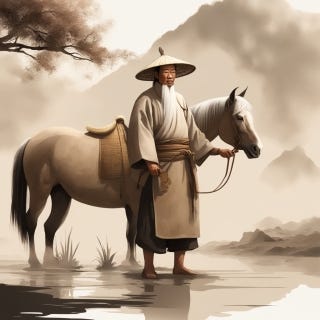
There is an old story about a Taoist farmer that I like:
The farmer’s horse ran away. It was nowhere to be found.
His concerned neighbors came by in the evening to give him their sympathies about the loss of his horse and his bad luck.
The farmer shrugged and to his neighbors about his bad luck, and said,"May-be."
The following day, his horse returned, but brought with it four wild horses.
His neighbors came by again and exclaimed about his good fortune this time. The farmer said, "May-be."
The next day, his eldest son tried to tame one of the wild horses, fell off and broke his arm.
Again, the neighbors came by to offer their sympathy for his misfortune. The farmer said, "May-be."
The following day Chinese army conscription officers came by to the village to seize young men for the army.
But — because of the farmer's son had a broken arm, he was rejected.
The neighbors once again stopped by to say how fortunate the farmer was. The farmer simply said, "May-be."
This illustrates what is meant by non-action. Intuitively knowing when not to act. The Tao brought the farmer good fortune from his bad luck. If the farmer would have acted differently, his son would have been taken away to be enlisted in the army. A son he needed to help him with his farm.
If we view the Tao as a force, as a inexplicable energy or essence, then we can believe that this is something we can use.
Often, it has been described as "Going with the Flow." That meaning is to not resist. It is like a man that has fallen into a fast moving, rapid flowing river. He is moved along by the force of the water which he has no control over. It does no good to flail around, the currents carry him along. He is unable to extricate himself, there are no rocks or branches he can grab onto. In this situation, it is best to just let the river take him down the river to calmer waters where he can get himself out of the slower moving current. Resisting the faster moving current would have exhausted him and perhaps he could have drowned. He only had to keep his head above water and go with the flow of the water.
From the Tao Te Ching:
The tao that can be described
is not the eternal Tao.
The name that can be spoken
is not the eternal Name.
The nameless is the boundary of Heaven and
Earth.
The named is the mother of creation.
Freed from desire, you can see the hidden
mystery.
By having desire, you can only see what is visibly
real.
Yet mystery and reality
emerge from the same source.
This source is called darkness.
Darkness born from darkness.
The beginning of all understanding.
[McDonald translation]
To understand the Tao, one must focus on the intuitive side of life. Now this means that one should not analyze his or her situation, condition or even problem, but rather with an inner knowing that one gains from meditating inwardly, one feels The Way.
Like the river water that carried the man down the river, the Tao can also be thought of as a river, a gently flowing essence that carries man (or woman) through life. If you resist these waters, you are resisting life. You might call this Destiny or Fate. Regardless, it is the flow of your life. Use it to your benefit.
In Taoism, the symbol, the element of water is used a lot and captures the essence of the philosophy.

From The Way of Life by Lao Tzu:
Man at his best, like water,
Serves as he goes along:
Like water he seeks his own level,
The common level of life,
Loves living close to the earth,
Living clear down in his heart,
Loves kinship with his neighbors,
The pick of words that tell the truth,
The even tenor of a well-run state,
The fair profit of able dealing,
The right timing of useful deeds,
And for blocking no one's way
No one blames him.
[Bynner translation]
So, what does the above mean?
'Man at his best, like water' -has to do with flowing around obstacles and being flexible, being humble, finding harmony and balance. Going with the flow of life and not resisting it. He or she is adaptable like water, but also with the strength that water can have.
'Serves as he goes along' -this is helping and serving others, being a good neighbor. Benefiting others.
'Like water he seeks his own level' -this is a reference to water again, of finding balance and harmony in life. Striving to find your ideal, natural place in the world.
'The common level of life,
Loves living close to the earth' - this means being grounded, living simply, being contented with life, being in harmony with the earth.
'Living clear down in his heart' -True to one's self, self-awarness, sincere. Feeling and acting with your heart.
'Loves kinship with his neighbors' -This has to do with community spirit and harmony with others. Genuine sincere communications.
'The pick of words that tell the truth' -to be honest and truthful with others. Clear communications.
'The even tenor of a well-run state' -Honesty and directness, fairness in communication. Peaceful harmony in society
'The fair profit of able dealing' -Ethical and fair dealings with others. Being moral.
'The right timing of useful deeds' -Wisdom in understanding the correct, appropriate time to act.
'For blocking no one's way
No one blames him' -like water, not obstructing, being in harmony, not opposing, avoiding conflict, noninterference — and so there is no fault.
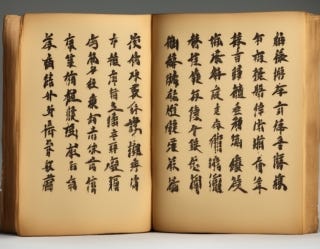
The opening of the book, The Way of Life by Lao Tzu is as follows:
Existence
is beyond the power of words
To define:
Terms may be used
But are none of them absolute.
In the beginning
of heaven and
earth
there were no
words,
Words came out of the womb of matter;
And whether a man dispassionately
Sees to the core of life
Or passionately
Sees the surface,
The core and the surface
Are essentially the same,
Words making them seem different
Only to express appearance.
If name be needed, wonder names them both:
From wonder into wonder
Existence opens.
[Bynner translation]
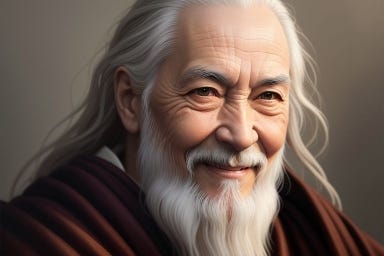
Taoist philosophy is at least 2,500 years old. It is still a living philosophy in China.
Early, significant Taoist philosophers:
Lao Tzu (Laozi) - Traditionally 6th century BCE (although some scholars place him in the 4th century BCE). He is credited with founding the Taoist philosophy. He wrote the famous Taoist book, The Way of Life / Tao Te Ching. His name Lao Tzu or Laozi actually means 'Old Master'. Note that the Tao Te Ching is the original Chinese title, whereas The Way of Life is a poetic translation by Witter Bynner.
Zhuangzi (Chuang Tzu) - ca. 369–286 BCE. He wrote the book, Zhuangzi, which bears his name.
Liezi - ca. 5th or 4th century BCE
Zhang Daoling - ca. 34–156 CE
Ge Hong - ca. 283–343 CE
Wang Bi - ca. 226–249 CE
There are others but these are the most notable.
Wu Wei
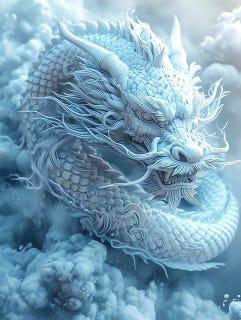
Wu wei means appropriate non-action. This is not forcing things, but allowing them to happen naturally. This is the case with the farmer and the horse that ran away. Wu Wei literally means "do nothing," "without action" or "not doing". So, it would mean, "not to act." So with wu wei, you are aligning yourself with the Tao, not against it — not working against it, but in harmony with it. You work with the natural flow of things.
From the Tao Te Ching:
The Master acts without doing anything and teaches without saying anything.
Things arise, and he lets them come; things disappear, and he lets them go.
He has, but he doesn't possess; acts, but has no expectations.
When his work is done, he forgets it.
That is why it lasts forever.
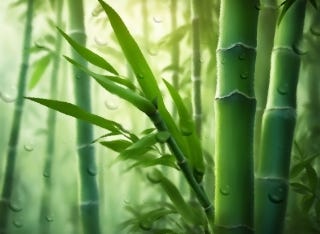
In the parable about the bamboo, the bamboo bends under the weight of snow instead of resisting it, while nearby trees snapped under the pressure. When the snow melts and is gone, the bamboo resumes its original position, symbolizing resilience through flexibility. This teaches being flexible and adapting to circumstances.
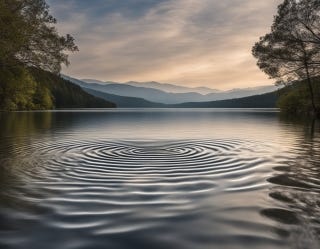
A sage compared a wise man to still water. He said when a stone is thrown into the water, it ripples outward but eventually settles back into tranquility. The sage noted that a wise person acknowledges disturbances in his life but does not allow them to disrupt their inner peace. He is resilient.
A farmer nurtured his crops diligently, never hurrying or forcing them to grow. Instead, he paid close attention to the natural patterns of the seasons, planting and harvesting at appropriate times without exceeding the plants' natural capacities. Allow things to evolve at their own pace. There are rhythms to nature and life.
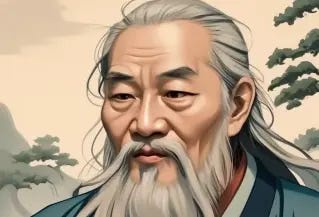
A great Taoist Master said, "All things are subject to the Great Tao. They are maintained by the Tao and never exceed the natural course of this essence. All who abide by the Tao will be successful in their endeavors."
What we look for beyond seeing
And call the unseen,
Listen for beyond hearing
And call the unheard,
Grasp for beyond reaching
And call the withheld,
Merge beyond understanding
In a oneness
Which does not merely rise and give light,
Does not merely set and leave darkness,
But forever sends forth a succession of living things
As mysterious
As the unbegotten existence to which they return.
That is why men have called them empty phenomena,
Meaningless images,
In a mirage
With no face to meet,
No back to follow.
Yet one who
is anciently aware of existence
Is master of every moment,
Feels no break since time beyond time
In the way life flows.
From The Way of Life [Bynner translation]
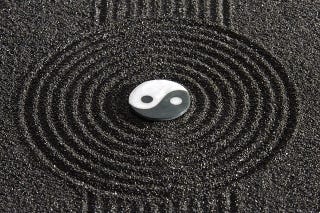
Yin and Yang
This is a fundamental concept and represents the balance of opposite forces in nature and within us. Although in a sense they are opposites, they also compliment each other and work in harmony. Intuition and feeling often arise from the harmonious interaction of these contrasting elements, highlighting the importance of acknowledging and embracing both sides. It is a dynamic balance and interplay.
The interaction of these dual forces create harmony and balance in the Cosmos. One cannot exist without the other. They are primary forces. They are interdependent and influence one another. There is always an interaction between Yin and Yang, feminine and masculine, negitive and positive, dark and light, the nurturing receptive and the active expansive....
Yin and Yang are those forces which create the universe, and thus the Tao. It is the interplay of this dual force that is responsible for the functioning of existence.
The I Ching (pronounced as 'ee jing') or The Book of Changes is also a significant writing in Taoism. It is also encompasses other philosophies such as Confucianism. In the I Ching we see the great symbolic interplay between Yin and Yang. Although the book is philosophical, it has also been used for guidance and diviniation.
Taoist Master: When we see the world through the eyes of a Taoist, we will see the world as a Superior Man does. The ebb and flow of existence is the Tao. It demands nothing and its being is as natural as the rain and the sun.
Taoist Master: The Tao is not something seen, but something felt. It is felt by the heart and is comprehended by the mind. It is invisible, but always present.
Through non-action, action is manifest. The concept of not-doing is the most difficult to understand, but sometimes, it is the most important. It is Wu Wei. Align yourself with the flow of the universe.
How does one Intuit Taoism?
In other words, using intuition to find the correct course of action.
Expand or cultivate awareness. Mindfulness can be practiced. Meditate; quiet the mind and look for — be aware of patterns and rhythms in life. Meditate on those patterns; feel them.
Accept the nature of change. Know that everything changes. Remain flexable. Stay inwardly balanced and grounded. Understand, and be open to the connections and balance of Yin & Yang.
Practice non-interference. Align yourself with the events in your life. This means to feel the natural flow of things, not to control the flow. Reflect on your experiences and their patterns. Remember the idea of Wu Wei, appropriate non-action or effortless action.
Find time to commune with nature and feel its essence. Nature will reflect the Tao to a large degree.
Taoist Master: “Get in touch with the Harmony of the Universe.” This is something one figures out for themselves.
Study Taoist texts such as Tao Te Ching, Zhuangzi and the I Ching as well as read books on Taoism.
In my experience, you approach the Taoist philosophy from the fringes. You start from the edges and work yourself to within. It's an inutitive, feeling, learning experience. The further in you go, the more you comprehend.

I love Taoism, Thank you for these beautiful reminders with these beautiful stories.